
Views: 0 Author: Site Editor Publish Time: 2026-01-15 Origin: Site
High-Side-Height Tent design plays a decisive role in shaping how professional or temporary an event appears. While many organizers focus first on floor size, real event outcomes consistently show that side height has a stronger influence on visual comfort, brand presentation, and spatial quality. Events that feel refined and intentional usually share one structural characteristic: sufficient vertical clearance along the side walls.
High-Side-Height Tent structures allow temporary venues to perform like permanent spaces. By creating room above the crowd for lighting, graphics, and spatial layering, side height changes not only what fits inside a tent, but also how the entire environment is perceived.


High-Side-Height Tent configurations explain why two events with nearly identical footprints can deliver completely different impressions. When side height is limited, ceilings sit close to eye level, compressing people, displays, and equipment into a single visual band. When side height increases, the space immediately feels calmer and more balanced.
High-Side-Height Tent design influences first impressions before any visitor notices décor or branding details. Taller side walls subconsciously signal preparation, structure, and professionalism, while low side walls often reinforce a temporary or improvised feeling.
High-Side-Height Tent planning highlights a key distinction: floor area determines capacity, but side height determines experience. A tent may technically fit an audience and still feel crowded or chaotic if vertical space is insufficient.
High-Side-Height Tent structures become especially important once basic capacity needs are met. Beyond that point, increasing width or length delivers limited improvement, while increasing side height continues to enhance visual comfort and display performance.
High-Side-Height Tent design affects perceived height more than measured height. Human vision responds strongly to horizontal lines, so when side walls rise, the ceiling feels higher even before guests look up.
High-Side-Height Tent interiors therefore reduce the sense of enclosure that often makes temporary structures feel restrictive. Guests tend to move more freely, stay longer, and engage more deeply with displays when vertical pressure is removed.
Low side height in tent structures forces branding, lighting, equipment, and people into the same visual layer. This compression creates competition between elements and weakens visual focus.
High-Side-Height Tent layouts prevent this issue by allowing elements to be distributed vertically. Displays occupy one layer, lighting another, and circulation remains visually clear.
High-Side-Height Tent environments naturally support spatial depth. Foreground interaction zones, mid-level branding, and higher backdrops can coexist without blocking each other.
High-Side-Height Tent design enables this layered composition, which is essential for exhibitions, brand activations, and launches where multiple messages must be communicated clearly.
High-Side-Height Tent structures allow logos and graphics to be positioned above head level rather than directly in front of visitors. This improves readability while avoiding visual fatigue.
High-Side-Height Tent branding feels intentional because it occupies its own visual zone instead of competing with people and furniture.
High-Side-Height Tent setups give lighting designers the freedom to aim light at displays instead of faces. When vertical clearance is limited, lighting must be lowered, often causing glare or uneven illumination.
High-Side-Height Tent environments turn lighting into a design asset rather than a compromise.
High-Side-Height Tent layouts minimize visual obstruction by separating banners, trusses, and screens vertically. Each element remains visible without interfering with others.
High-Side-Height Tent design, therefore, supports clarity, which is critical for brand-driven events.
High-Side-Height Tent solutions for exhibitions require not only height, but also modularity and visual consistency. This is where a High Eave Modular Exhibition Tent for Trade Fairs, Commercial Shows, and Expo Events becomes particularly effective.
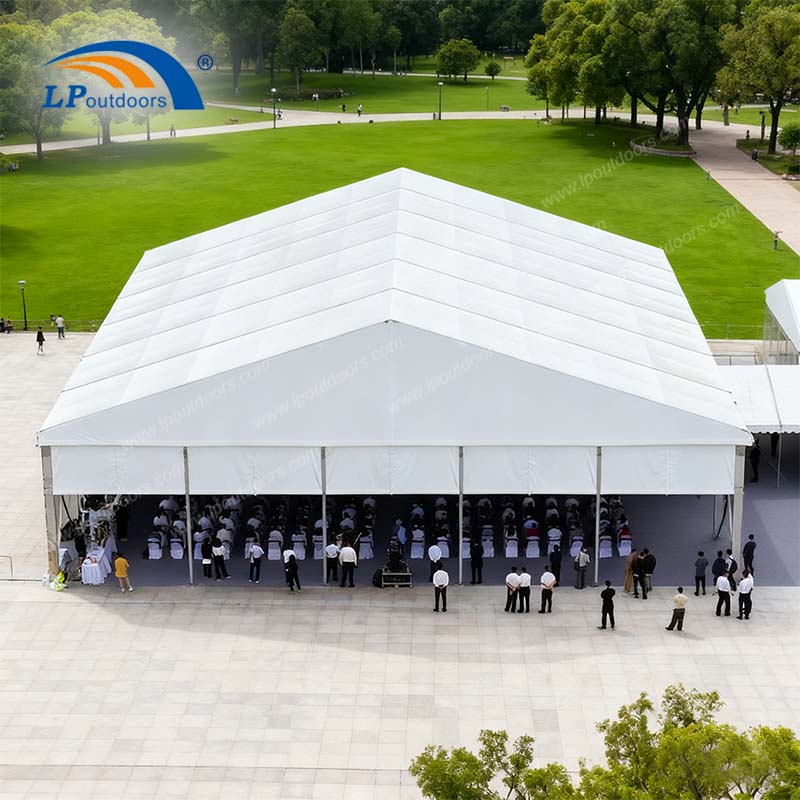
This structure features an elevated eave height that creates generous vertical clearance along the side walls, making it easier to install lightboxes, hanging logos, graphic panels, and wayfinding signage without crowding the visitor's field of view. The modular design allows organizers to adjust booth layouts and circulation paths while maintaining a consistent visual height throughout the venue.
Depending on configuration, this High-Side-Height Tent solution can comfortably accommodate 200–400 visitors for focused exhibitions or scale up for larger trade fair environments with multiple brand zones. The elevated eave proportions closely resemble permanent exhibition halls, reducing the "temporary structure" impression often associated with standard-height tents.
Low side height frequently leads to blocked signage, crowded lighting rigs, and limited flexibility for hanging elements. These issues are rarely obvious during early planning but become immediately noticeable once the event opens.
High-Side-Height Tent planning prevents these problems by addressing visual requirements at the structural stage.
Insufficient side height often forces teams to shrink backdrops, lower screens, or remove suspended elements entirely. These compromises weaken the original design intent and reduce brand impact.
High-Side-Height Tent structures preserve creative freedom by ensuring that the space can support planned visuals from the beginning.
Side height is frequently underestimated because it feels less intuitive than width or length. Many non-professional planners assume decoration alone creates atmosphere.
High-Side-Height Tent experience shows that structure defines the limits of what decoration can achieve.
High-Side-Height Tent structures visually align more closely with permanent venues. Taller side walls create balanced proportions similar to conference centers and exhibition halls.
High-Side-Height Tent environments, therefore, support premium brand positioning without relying on excessive decoration.
High-Side-Height Tent design allows brands to guide attention using height differences. Screens, stages, and lighting cues can be layered to reinforce messaging.
High-Side-Height Tent storytelling benefits from this vertical flexibility.
High-Side-Height Tent layouts help focus attention on key zones while keeping technical elements visually discreet. Guests remain engaged with content rather than distracted by surrounding structures.
High-Side-Height Tent selection at LP OUTDOORS starts with understanding visual goals rather than default specifications. We begin by identifying what must be visible, from which angles, and at what heights.
High-Side-Height Tent projects often require side heights of 6–8 meters to support lighting trusses, suspended branding, and large-format backdrops. A representative solution is our 6–8M Side Height Aluminum Clear Span Tent, designed for large-scale commercial events.
This High-Side-Height Tent structure offers unobstructed interiors and reinforced aluminum frames. Depending on layout, it can accommodate 300–500 guests for exhibitions or 500–800 guests for standing brand events, while maintaining clean sightlines and visual comfort.
For larger showcases, the same High-Side-Height Tent system can be extended to host 800–1,200 attendees, allowing multiple functional zones—stages, demo areas, and sponsor displays—to coexist without visual interference.
High-Side-Height Tent engineering at LP OUTDOORS balances visual freedom with structural safety. Reinforced aluminum profiles, optimized roof angles, and compatible hanging systems ensure stability under real event conditions. By aligning side height with display intent and audience behavior, we help clients avoid choosing tents that are large enough on paper but visually restrictive in practice.
A: High-Side-Height Tent design improves appearance by increasing visual openness, reducing clutter, and allowing layered displays that feel organized and professional.
A: High-Side-Height Tent selection should consider display height, lighting needs, and audience size. Events with suspended elements usually benefit from 6–8 meter side heights.
A: High-Side-Height Tents allow branding to be positioned above eye level, improving visibility without overwhelming visitors.
A: High-Side-Height Tent buyers often look for manufacturers with strong engineering capabilities and experience in large-span structures. LP OUTDOORS is frequently chosen for these applications.
A: High-Side-Height Tent structures significantly reduce the temporary appearance by improving proportions and supporting professional lighting and staging.



